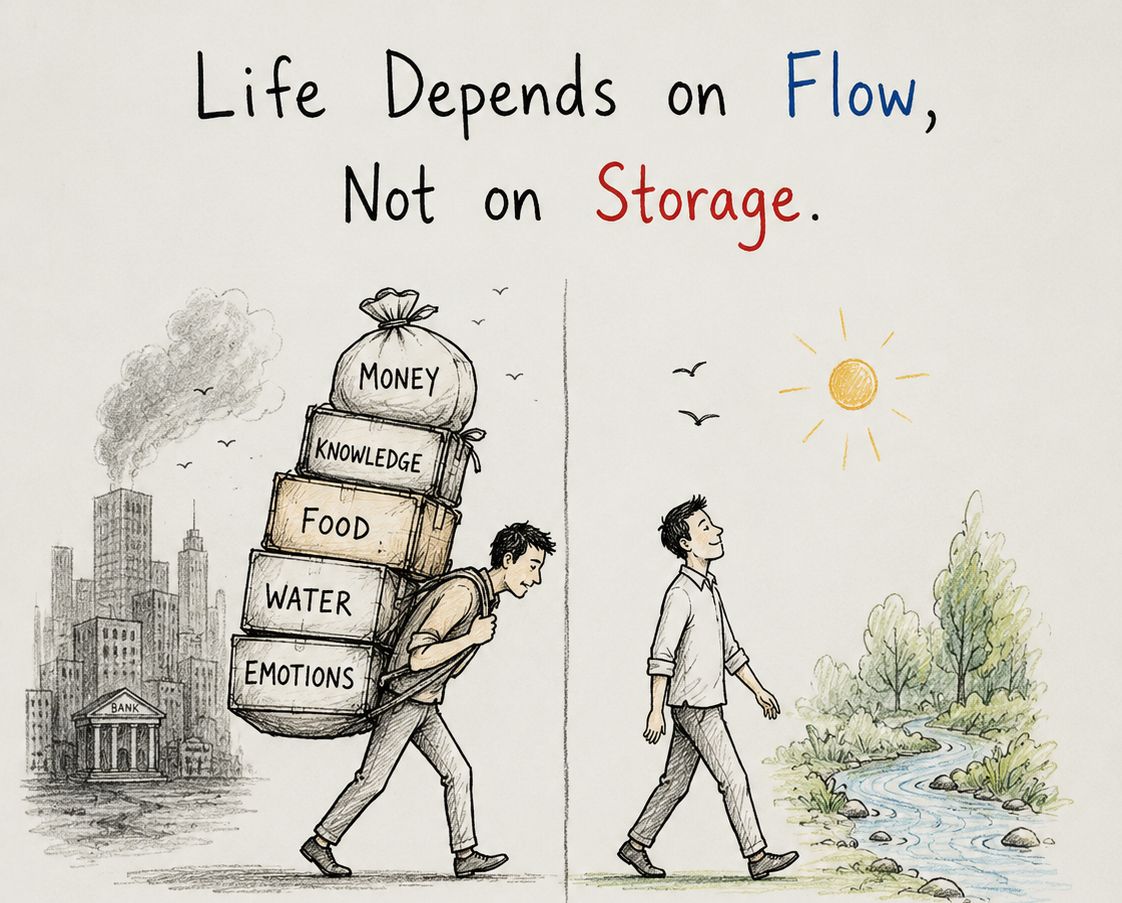
Humans believe that storing more creates security. We store money, food, knowledge, possessions, data, and even emotions. Yet, nature tells a very different story.
Look around the natural world. Most animals gather what they need and move on. Some species store food for seasons of scarcity, but almost none accumulate endlessly. They don't spend their lives collecting far beyond their needs. Humans, however, have turned storage into a way of life.
When money is stored instead of circulating, economies slow down. Businesses sell less, workers earn less, and growth weakens. Money creates value only when it moves.
The same principle exists inside our bodies.
Energy that is not used is stored as fat. Over time, excess fat can lead to obesity, diabetes, heart disease, and many other health problems. The body was designed for movement, not endless accumulation.
Water tells the same story. Flowing water stays fresh. Water trapped for too long becomes stagnant and polluted. Movement keeps it alive.
Knowledge is no different. Information that is never applied often becomes mental clutter. We keep consuming books, articles, videos, and opinions without acting on them. Instead of creating wisdom, this overload can lead to anxiety, confusion, and the fear of never knowing enough.
Even emotions follow this law. Feelings that are never expressed or processed build up over time. What begins as stress can become anxiety, depression, resentment, or burnout.
Nature seems to follow one simple principle: life depends on flow.
Blood must flow.
Air must flow.
Water must flow.
Energy must flow.
Money must flow.
Knowledge must flow.
Love must flow.
The problem is not storage itself. Storage is necessary for survival. The problem begins when storage replaces circulation. What was meant to be a reserve becomes a burden.
Perhaps true wealth is not measured by how much we can accumulate, but by how well we can circulate what we have for our own well-being and for the well-being of others.
Maybe the healthiest life is not one with the biggest storage, but one with the healthiest flow.
share your thoughts and more examples
The Hidden Price of More
“"He who knows that enough is enough will always have enough." — Lao Tzu”
Did you enjoy this?
Share this post